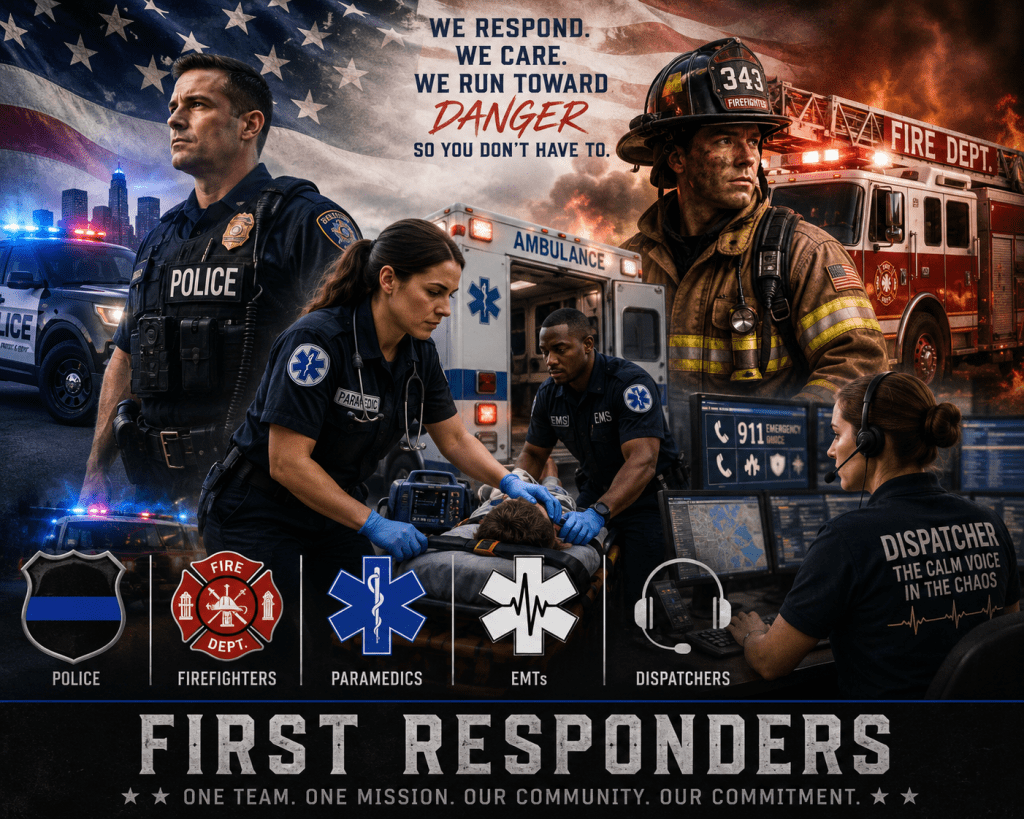
For more than three decades, I have walked in the shoes of a first responder. I initially entered the profession seeking life experience and a deeper understanding of the human condition. At the time, I was searching for clarity about my vocational calling and the direction of my life.
From an early age, I sensed a call toward ministry. While attending college courses seeking my bachelor’s degree, I approached an Episcopal priest about this call to ministry.
Over the four years at this university, we had many conversations about life. Some of the conversations were light and others were intellectually deep and spiritual. I believe it was all these conversations that he thought that I was spiritually sincere but still immature.
He was blunt about one conversation and told me that I was a naïve about the realities of the world. He encouraged me to spend time working in a profession that would expose me to real life, human suffering, and the complexities of people. His belief was that such experiences would help shape both my character and my understanding of ministry.
So, I became a police officer.
Over the years, that profession became far more than a career. It became an education in humanity itself. The men and women who also served in this field provided me with something that is hard to describe. Citizens think this is the silent code of protection. It was not that, but something deeper. If you have never experienced the Thin Blue Line, the Thin Red Line, the Thin Gold Line, or the Thin White Line, you’ll never understand the bond these men and women have.
I witnessed courage and cruelty, compassion and violence, faith and despair. I encountered people on the best days of their lives and on the worst moments imaginable. Through those experiences, I not only learned about the world around me, but also about my spirituality. I saw suffering, resilience, and the profound need for hope in the lives of both first responders and the communities they serve.
First responders walk through realities that most people never encounter. They see humanity at its absolute best and its absolute worst. Often these encounters happened within the same hour.
One moment may involve comforting a grieving parent, responding to violence, or witnessing a death. The next may require standing calmly in a convenience store, answering routine questions, or speaking casually with people who have no idea what was seen minutes before.
This emotional and spiritual transition is one of the greatest hidden burdens carried by law enforcement officers, firefighters, paramedics, dispatchers, and chaplains.
While the uniform or badge may identify the profession, it does not shield the human soul from what is repeatedly absorbed over years of service.
The challenge for many first responders is not merely surviving traumatic events, but remaining spiritually grounded while continually moving between tragedy and normalcy.
First responders often live in two parallel worlds.
One world is the public world consisting of ordinary routines of family dinners, conversations with neighbors, school events, and everyday interactions. In this world, most people still believe society is generally safe and predictable.
The second world is the hidden world of emergency response. It is the world of overdoses, suicides, child abuse, fatal crashes, domestic violence, shootings, murder, fires, and human suffering.
First responders know how fragile life truly is because they see the evidence of that fragility daily. Others only experience these things a few times in their life time and never to the degree of a first responder.
The emotional difficulties come from moving constantly between those two realities.
A paramedic may perform CPR on a child and later stop for coffee while strangers discuss sports scores nearby. A police officer may spend hours handling violence and then immediately attend a community event or a local school function. A firefighter may pull victims from destruction and later smile politely through ordinary conversation when a child wants to see the firemen and their truck.
Over time, this emotional whiplash can quietly affect their spirituality, relationships, identity, and mental health.
Human beings were not designed to repeatedly witness trauma without consequence. Even highly trained professionals absorb emotional residue from suffering.
Not all first responders will take the time to reflect on their life and the exposures they experience. Some may begin asking the difficult spiritual questions:
Why do innocent people suffer?
Why does evil seem so common?
Why do some survive while others die?
Where is God during tragedy?
How do I continue believing in goodness after seeing so much darkness?
These questions are not signs of weak faith. They are signs of honest humanity which can lead towards spiritual resilience.
Spirituality in emergency services is not about pretending trauma does not exist. It is about learning how to carry the weight of human suffering without allowing it to destroy one’s compassion, hope, or purpose.
For first responders, spirituality cannot simply be theoretical. It must become intentional, and practical. It is necessary for them to be grounded in life.
Spirituality is not denial of pain. It is the ability to remain centered while standing in pain.
A spiritually grounded first responder understands several truths:
Evil exists, but it does not define all humanity.
Trauma is real, but so is resilience.
Death is present, but so is compassion.
Human cruelty exists, but acts of courage and kindness exist equally.
First responders witness extraordinary goodness that the public rarely sees. They see strangers rush into danger to help others. They see families love each other through devastating circumstances. They see partners risk their lives for one another and those they do not know. They see ordinary citizens become heroes in critical moments.
The same profession that exposes darkness also reveals remarkable light.
One of the greatest spiritual dangers within the first responder community is emotional numbing.
To survive repeated trauma, some responders unconsciously shut down emotionally. Dark humor, emotional distance, cynicism, irritability, or isolation can become protective mechanisms. While these coping tools may temporarily reduce pain, they can also slowly disconnect a person from empathy, relationships, and spirituality.
A first responder may still function professionally while internally becoming exhausted, detached, or spiritually empty.
Spiritual health requires intentional reconnection with their faith and faith practices.
That reconnection must involve:
Prayer
Meditation
Quiet reflection
Time in nature
Conversations with trusted peers
Counseling
Worship
Journaling
Chaplain support
Reading sacred texts
Practicing gratitude
Honest emotional processing
Spirituality is strengthened not by suppressing emotions, but by acknowledging them honestly.
Many first responders often feel isolated because few people truly understand their experiences. Family and friends may care deeply but still struggle to comprehend the emotional realities of the job.
This is why a spiritual community matters.
Healthy peer support, chaplain programs, faith communities, and trusted friendships provide places where responders can speak honestly without fear of judgment. Isolation magnifies emotional injury. Community helps carry it.
Even the strongest first responder was never meant to carry the burdens they experience alone.
One of the hardest lessons for first responders is learning the difference between compassion and ownership.
Compassion means caring deeply for people. Ownership means carrying responsibility for every tragedy encountered.
As a first responder, you can’t save everyone. You can’t undo every traumatic event. You can’t change every broken situation.
Spiritual maturity involves recognizing human limits while still serving faithfully and compassionately.
A first responder’s role is often not to fix every problem, but to bring professionalism, dignity, calmness, protection, and compassion into moments of chaos.
Sometimes the greatest act of service is simply being present during another person’s worst moment.
Without the ability to be spiritual grounded, their work can slowly become defined only by stress, paperwork, conflict, and trauma. Over time, they may forget why they entered the profession in the first place.
Spiritual reflection helps restore meaning.
Many first responders entered their profession because they wanted to help others, serve their community, protect life, and stand between danger and the innocent.
The first responder, after seeing many conflicts and disturbances and believe they are to bring order to the chaos they witness.
Those values matter deeply. Purpose becomes a stabilizing force when trauma threatens emotional exhaustion.
A first responder knows better than most people how broken the world can be. Yet many also become witnesses to extraordinary resilience.
They see people survive overwhelming tragedy. They see communities unite after disaster. They see forgiveness after violence. They see courage in suffering. They see life continue after loss.
Spirituality does not remove exposure to darkness. It provides the strength to continue walking through darkness without becoming consumed by it.
I think about my journey, I have come to realize that the human condition contains beauty and brutality, compassion and cruelty, hope and suffering. I, along with many colleagues have been standing at the intersection of all of it.
To serve in that environment requires more than physical endurance or professional training. It requires spiritual resilience.
Maintaining spirituality is not weakness. It is maintenance of the soul.
Just as emergency vehicles require fuel, maintenance, and repair after miles, first responders also require restoration after difficult calls.
A spiritually healthy responder is not someone untouched by trauma, but someone who continues seeking meaning, compassion, balance, and hope despite repeated exposure to humanity’s hardest moments.
In many ways, spirituality becomes the quiet foundation that allows first responders to continue serving others while still remaining human themselves.


Leave a Reply